
Importance of PSA Oxygen Plants in Wastewater Treatment
- Importance of Oxygen Under Wastewater Treatment
- How a PSA Oxygen Plant Works
- Comparison of Aeration Approaches
- About Shelves Tech
- PSA Oxygen Plant Cost in India and Investment Considerations
- PSA Oxygen Plant Price and Market Dynamics
- Selecting an Appropriate PSA Oxygen Plant for Wastewater Treatment
- Frequently Asked Questions (FAQs)
- Conclusion
The wastewater treatment process plays an important role in a city's or industry’s ability to have a sustainable industrial infrastructure. To change contaminated water into treated water that meets all environmental standards is dependent upon utilizing biological treatment processes such as activated sludge and membrane bioreactors. The amount of oxygen available to each of these processes is important to the efficiency of treatment. This is where an onsite/off-gasification process through a PSA Oxygen Plant is able to provide an extremely reliable/high-purity source of oxygen used for aeration and provides a method of improving the overall efficiency of the wastewater process while also decreasing the long-term cost of wastewater facilities.
Importance of Oxygen Under Wastewater Treatment
Aerobic bacteria can live only with oxygen, and they require sufficient amounts of dissolved oxygen (DO) in order to stay active as nutritional feeders on organic pollution. The uses of these bacteria in biological wastewater treatment are dependent on their ability to consume large quantities of organic pollutants. If there is inadequate DO available, the activity of bacteria will be reduced either to a slower rate or partly anaerobic, which will result in incomplete treatment of the wastewater, bulking of sludge, and foul odours.
A pressure swing adsorption PSA Oxygen Plant Suppliers concentrated oxygen directly to an aeration basin, which increases the level of DO faster than conventional air blowers, enabling
- Treatment capacity to be increased in the same volume of tank space.
- Organic load degradation occurs more rapidly.
- The removal of nitrogen and phosphorus compounds to occur better.
- Stable operation to occur at fluctuating influent loads.
Operators of cities and industries that need to meet effluent discharge limits to be cost-effective may gain a distinct advantage by utilizing an on-site source of oxygen.
How a PSA Oxygen Plant Works
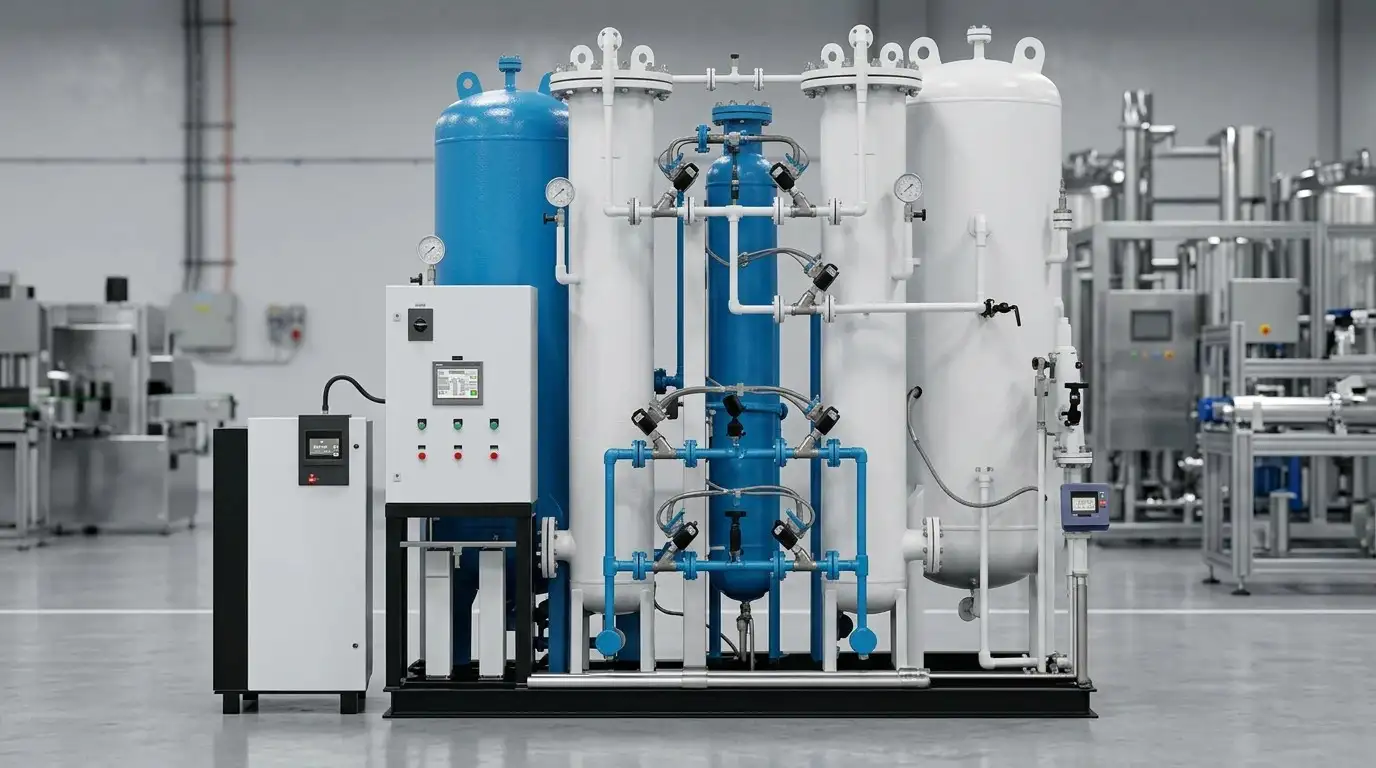
Oxygen is extracted from ambient air using a gas-separation technology called "pressure swing adsorption" (PSA). Behind the PSA Oxygen Plant Working Principle is the use of a molecular sieve as a means of separating nitrogen from the atmosphere and then utilizing the principle behind pressure swing adsorption in order to release oxygen when the pressure is reduced.
The overview of PSA oxygen plants:
- Air Compression and Filtration: From the atmosphere, it is compressed and then filtered to remove all impurities.
- Adsorption of Nitrogen: The nitrogen in the air will adhere to the sieves at high pressure while the oxygen molecules will pass through to the collection point.
- Pressure Swing and Desorption: Once the sieves are saturated with nitrogen, the pressure is instantly lowered to create an opening for the nitrogen to be released from the sieves to be regenerated.
- Dual‑Tower Operation: A minimum of two vessels are used while one vessel is collecting a charge by adsorbing nitrogen, and the other vessel is regenerating and releasing the adsorbed nitrogen, thus allowing a continuous flow of oxygen.
- Oxygen Collection and Storage: The collected oxygen is stored and delivered to the aeration system as required.
This method of producing oxygen from the atmosphere generally results in an oxygen concentration of 90 - 95% compared to traditional air-blower systems, allowing for a faster transfer of mass and a more efficient use of energy delivered per unit of oxygen generated.
Comparison of Aeration Approaches
| System Type | Oxygen Source | Supply Reliability | Energy Efficiency | Best For Wastewater Treatment |
|---|---|---|---|---|
| Air Blowers | Ambient air (~21% O₂) | Continuous but low purity | Moderate | Basic, low-load plants |
| Liquid Oxygen | Cryogenic tanks | Dependent on deliveries | High at plant, losses onsite | Large plants with stable logistics |
| PSA Oxygen Plant | 90–95% O₂ from air | On-site, continuous | High per kg of oxygen | High-load, high-efficiency plants |
This table highlights the PSA oxygen plant’s advantages in delivering stable, efficient oxygen supply with reduced reliance on external logistics.
About Shelves Tech
'In the field of industrial automation and healthcare solutions, Shelves Tech is the trusted and reliable name and was founded in the year 2013. The company delivers the best quality products and has great industry experience. The company offers a wide range of solutions, like linear accelerators, health ATMs, and advanced oxygen generation systems—all equipment that helps in healthcare system needs. Each product is designed according to the standard needs and with durability and accuracy for professional use in the long term. In the health care industry, Shelves Tech is expanding its presence. The platform also offers related products, like PSA oxygen plants, ECG machines, multipara monitors, etc. If you are thinking of investing in healthcare solutions, we are the best platform. You can easily connect with us to expand or start the business. Shelves Tech is committed to providing the best automation and electrical solutions to its customers.’
PSA Oxygen Plant Cost in India and Investment Considerations
The following are some of the many factors that will determine the PSA Oxygen Plant Cost in India.
- Plant capacity is based on Nm³/h (normal cubic meters/hour) or normal liters/min (volume flow).
- The desired level and pressure of oxygen purity.
- Degree of automation manual vs fully automated.
- Additional equipment that may be included with the plant, like compressors, dryers, filters, and controls.
- Installation, commissioning, and annual maintenance contracts (AMCs).
Depending on the size of the plant, many small and mid-sized projects can have a capital cost that is anywhere from the low end of the spectrum in lakhs to high-end crore ranges depending on specifications. In addition to the capital cost, this investment may be offset by:
- Lower operating costs than purchasing liquid oxygen or oxygen gas from cylinders.
- Lower energy requirements per kg of oxygen produced.
- Decreased logistics and storage concerns.
Several PSA Oxygen Plant Manufacturers in India, including Shelves Technologies and others, are able to manufacture made-to-order solutions that meet all wastewater treatment requirements for any budget, performance, or reliability.
PSA Oxygen Plant Price and Market Dynamics
The PSA Oxygen Plant Price depends on technology, brand reputation, and after-sales support. When choosing a supplier, consider the following:
- Energy efficiency and compressor quality
- Spare parts availability with service engineers
- Warranty terms and AMC offerings
- Compliance with BIS or other relevant standards
Shelves Tech understands the continuous-operation demands of wastewater treatment and provides robust control and monitoring systems.
Selecting an Appropriate PSA Oxygen Plant for Wastewater Treatment
Important steps in selecting an appropriate PSA Oxygen Plant:
- Oxygen Demand: Estimate how much oxygen will be required through an assessment of the biochemical oxygen demand (BOD) and retention time.
- Oxygen Purity and Pressure: Usually, 90%-94% pure and 1-3 bar gauge pressure provide sufficient performance. However, higher purities may increase costs without any real benefit.
- Footprint and Utilities: Verify if there is sufficient space and the utility connections, like stable electrical and cooling water, necessary for operation.
- Reliability and Service: Select OEM manufacturers with proven technical support, appropriate documentation, and a robust inventory of consumables. This helps you source only the right products for your industrial operations, thus contributing to work efficiency.
Shelves Tech’s more than two decades of industrial experience in advanced medical and industrial equipment can help you make an informed choice aligned with your technical and financial goals.
Related Blog You Might Be Interested In:
How Are On-Site PSA Oxygen Plants Transforming Healthcare Accessibility?
Frequently Asked Questions (FAQs)
1. What is a PSA oxygen plant and why is it used in wastewater treatment?
Ans: A PSA oxygen plant is a system that generates oxygen from atmospheric air using adsorption technology. In wastewater treatment, it is used to supply high-purity oxygen that supports aerobic bacteria in breaking down organic waste. This improves treatment efficiency, reduces processing time, and ensures better compliance with environmental standards.
2. How does a PSA oxygen plant work?
Ans: The PSA Oxygen Plant Working Principle is based on separating oxygen from air using molecular sieves. Compressed air passes through adsorption towers where nitrogen is trapped, allowing oxygen to flow through. The system operates in cycles, ensuring a continuous oxygen supply, which is essential for maintaining effective biological treatment processes.
3. What factors affect the PSA oxygen plant price?
Ans: The PSA Oxygen Plant Price depends on several factors, including plant capacity, oxygen purity level, automation features, and installation requirements. Additional components such as compressors, dryers, and storage systems can also influence the overall pricing. Customization and after-sales support may further impact the final cost.
4. What is the typical PSA oxygen plant cost in India?
Ans: The PSA Oxygen Plant Cost in India varies depending on the size and specifications of the system. Small-scale units are more affordable, while large industrial plants require a higher investment. However, the long-term savings on oxygen supply and operational efficiency make it a cost-effective solution for industries.
5. Why is oxygen important in wastewater treatment processes?
Ans: Oxygen plays a crucial role in supporting aerobic microorganisms that break down organic pollutants in wastewater. Adequate oxygen levels ensure efficient decomposition, reduce harmful emissions, and improve overall water quality. Without sufficient oxygen, the treatment process becomes slow and less effective.
6. What are the advantages of using a PSA oxygen plant over traditional oxygen supply methods?
Ans: PSA oxygen plants offer several benefits, including on-site oxygen generation, reduced dependency on cylinders, lower operational costs, and continuous supply. They also minimize transportation challenges and improve safety, making them a more efficient and sustainable option for wastewater treatment facilities.
7. How do I choose the right PSA oxygen plant manufacturer?
Ans: Selecting from reliable PSA Oxygen Plant Manufacturers in India requires evaluating factors such as product quality, industry experience, certifications, and after-sales service. A trusted manufacturer ensures consistent performance, durability, and technical support, which are essential for long-term operation.
8. Can PSA oxygen plants be integrated with existing wastewater treatment systems?
Ans: Yes, PSA oxygen plants can be easily integrated with existing treatment systems such as activated sludge processes, MBBR, and SBR. Their flexible design allows seamless installation, improving oxygen supply and enhancing the overall efficiency of the treatment process without major modifications.
Conclusion
PSA oxygen plants improve the treatment of wastewater by giving it a stable supply of high-purity oxygen. PSA helps bacteria to speed up the breakdown of pollution and makes things work better. They are a sustainable and cost-effective solution for modern wastewater treatment systems because they use less energy and cost and make reliable oxygen on-site.
For sourcing the PSA oxygen plants for your industrial needs, you can contact with us for high-quality machines.